
The world of artificial intelligence is buzzing with opportunity, but it’s also drowning in hype. For every groundbreaking success story, there are a thousand entrepreneurs wrestling with the same challenge: how do you move from a brilliant idea to a scalable, profitable AI business without the backing of a massive enterprise? It’s a common struggle that can feel overwhelming, leaving you stuck between ambitious goals and limited resources.
This guide is a different kind of playbook. Forget high-level theory and vague predictions. With our 5 years of experience in content creation and guiding businesses, we’ve crafted a step-by-step, capital-efficient roadmap designed for early-stage founders and lean teams. We’re cutting through the noise to give you a practical framework for real-world growth.
By the end of this guide, you will have an actionable framework to build your strategy, manage your costs, navigate critical challenges, and achieve sustainable growth in the competitive 2025 landscape.
Table of Contents
- The foundation: developing your lean AI business strategy for 2025
- Building your scalable tech stack without breaking the bank
- Navigating critical scaling challenges: costs, talent, and integration
- A practical framework for responsible and ethical AI growth
- What is the future of AI startups?
- Frequently asked questions about scaling an AI business
- From idea to impact: your journey in scaling starts now
The foundation: developing your lean AI business strategy for 2025
A powerful AI tool is worthless without a clear strategy to guide it. Many startups fail not because their tech is weak, but because their business plan is. To avoid this pitfall, you need a structured framework that aligns your technology with clear business goals from day one. This section provides that framework, giving you a solid foundation for every decision that follows.
Choosing your business model: wrappers, vertical AI, and agents
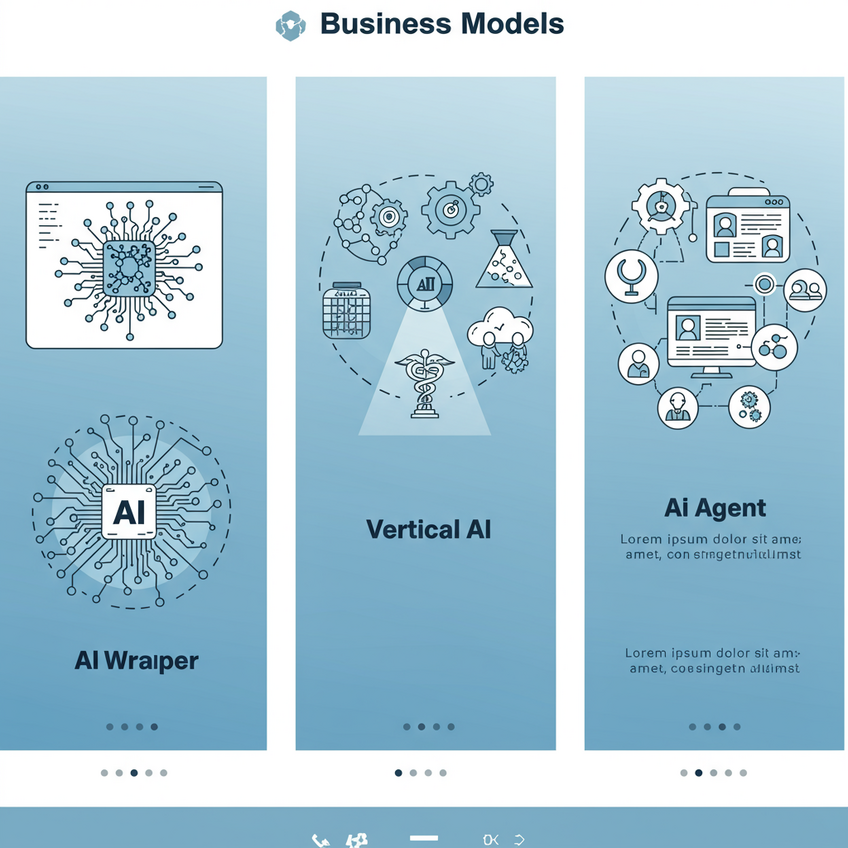
The first strategic choice is your fundamental business model. For a lean startup, three models stand out in 2025 for their accessibility and potential.
- AI wrappers: This is often the fastest way to market. You take a powerful, existing AI model (like one from OpenAI or Anthropic) and build a user-friendly interface or workflow “around” it to solve a specific problem. The value is in the user experience and specialized application, not the core model itself.
- Vertical AI: This is where the big opportunities for startups lie. Instead of creating a general-purpose tool, you build a specialized AI solution for a single industry or “vertical” (e.g., AI-powered diagnostics for dental offices or logistics optimization for local breweries). This focus allows you to solve deep problems for a specific audience and build a strong competitive moat.
- AI agents: This is a forward-looking but increasingly viable model. AI agents are autonomous systems designed to perform complex, multi-step tasks on behalf of a user. Think of a personal travel agent that can research flights, book hotels, and create an itinerary based on a simple prompt.
Here is a simple framework to help you decide:
| Business Model | Complexity | Scalability | Ideal For… |
|---|---|---|---|
| AI wrapper | Low | High | Founders who want to get to market quickly and test an idea with minimal technical overhead. |
| Vertical AI | Medium | Medium-High | Teams with some domain expertise who want to build a defensible, long-term business. |
| AI agent | High | High | Technically-proficient founders aiming to build next-generation applications with high value. |
Defining your vision and creating a phased implementation roadmap
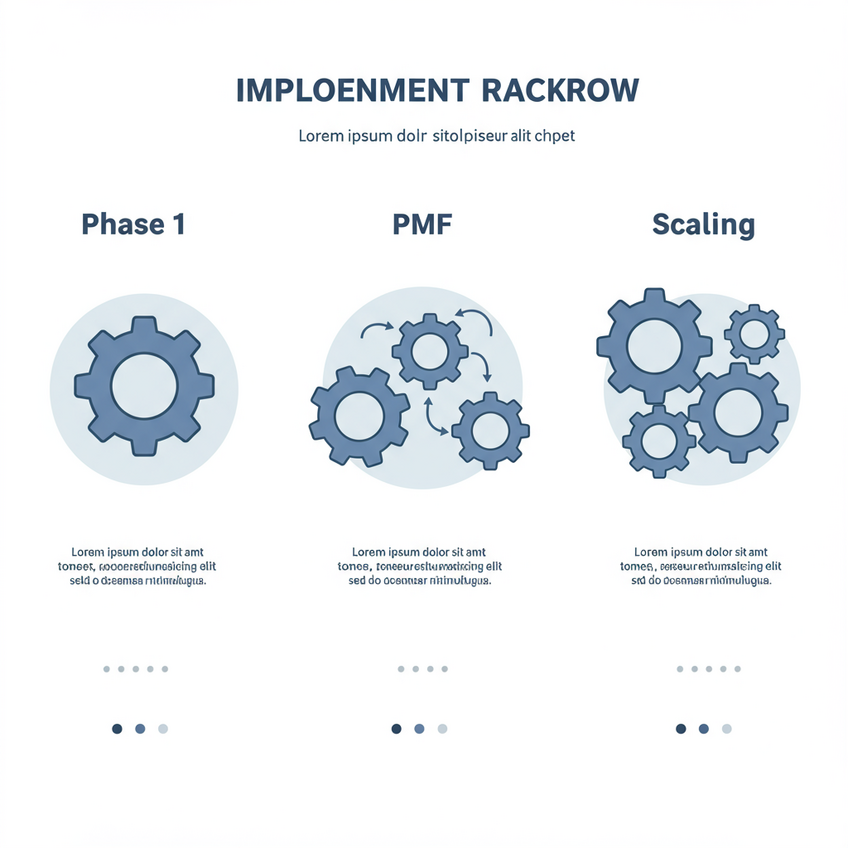
Moving from a pilot project to a full-scale production system is a common point of failure. A phased approach is critical to manage costs, reduce risk, and build something customers actually want.
- Phase 1: Minimum viable product (MVP): Your initial goal is not to build your entire vision. It’s to solve one core problem for one target user, exceptionally well. This focus is essential for getting to market quickly and validating your core assumption.
- Phase 2: Product-market fit (PMF): Once your MVP is live, the focus shifts entirely to user feedback. Use this phase to talk to your users, analyze their behavior, and iterate relentlessly on the product. Is it solving their problem? What features are they asking for? This is where you turn a good idea into a great product.
- Phase 3: Scaling: Only after you have clear signals of product-market fit should you focus on scaling. This involves expanding your feature set, optimizing your tech stack for more users, and ramping up your marketing and sales efforts.
This phased strategy ensures you don’t waste precious time and money building something nobody needs. As noted in PwC’s AI business predictions, a clear, strategic implementation plan is a key differentiator for successful AI adoption.
Rankenstein‘s strategic insight: focus on capital efficiency from day one
Here is a core truth for any AI startup not swimming in venture capital: you win by being smarter with your money. While heavily funded competitors can afford to burn cash on massive experiments, lean startups win by obsessing over capital efficiency.
This must become your guiding philosophy. Every strategic decision—from the business model you choose to the features you build—must be weighed against its cost and potential return on investment. Ask yourself constantly: “Is this the most capital-efficient way to achieve our next milestone?” This relentless focus on ROI is the heart of a no-nonsense approach to scaling. This focus on ROI is critical, just as we outlined in our Rankenstein Blueprint for Top-Ranking Articles.
Building your scalable tech stack without breaking the bank
Once your strategy is set, you need to build the technical foundation to support it. For an early-stage startup, the goal is not to build a perfect, enterprise-grade system from the start. It’s to build a lean, flexible, and scalable stack that can grow with you without incurring massive upfront costs.
Crafting a lean and scalable data infrastructure
At its simplest, data infrastructure is how you collect, store, and process the data that fuels your AI. You don’t need a complex, expensive system to get started.
- Start with the cloud: Use scalable, pay-as-you-go cloud storage solutions like Amazon S3 or Google Cloud Storage. They are cheap, reliable, and can handle virtually any amount of data you throw at them.
- Prioritize data quality over quantity: A small, clean, well-labeled dataset is infinitely more valuable than a massive, messy one. Implement data validation and cleaning processes from the very beginning.
- Consider synthetic data: When real-world data is scarce or expensive to acquire, synthetic data can be a game-changer. These are artificially generated datasets that can be used to train your models cost-effectively, especially in the early stages.
Your initial data flow can be as simple as this:
Data Sources -> Cloud Storage -> AI Model -> Application
MLOps for beginners: practical first steps
Don’t let the term “MLOps” intimidate you. It’s simply the practice of bringing automation and discipline to the machine learning lifecycle, just as DevOps did for software development. It helps you deploy, monitor, and manage your models reliably.
- Track your experiments: When you’re training models, you’ll be trying hundreds of variations. Use a tool like MLflow (open source) or Weights & Biases (offers a generous free tier) to log every experiment. This prevents you from losing track of what works and what doesn’t.
- Version your models: Just like you version your code, you need to version your models. This ensures you can always roll back to a previous version if a new one performs poorly in production.
- Start simple: You don’t need a complex, automated pipeline on day one. Start by manually tracking experiments and versioning models, then gradually automate parts of the process as you scale. Choosing the right tools is key, as we explored in our guide to the top AI tools for peak performance.
Leveraging automation to scale operations
Founder time is your most valuable resource. The more operational tasks you can automate, the more time you can spend on high-impact activities like talking to customers and refining your strategy.
Tools like Zapier and Make are invaluable for this. They allow you to create powerful workflows that connect different apps and services without writing a single line of code. For instance, we automated our content briefing process by connecting our project management tool to an AI text generator. When a new task is created, a detailed brief is automatically drafted and assigned, saving us nearly 10 hours a week of manual work.
You can apply this to almost any part of your business:
- Automatically classify and route incoming customer support tickets.
- Use AI to generate first drafts of marketing copy or social media posts.
- Automate lead enrichment by pulling data from various sources into your CRM.
Navigating critical scaling challenges: costs, talent, and integration
As you grow, you will inevitably face challenges. The most common hurdles for AI startups revolve around managing costs, finding the right talent, and integrating AI into existing workflows. Anticipating these challenges and having a plan to address them is crucial for survival.
Managing prohibitive costs: the GPU problem and beyond
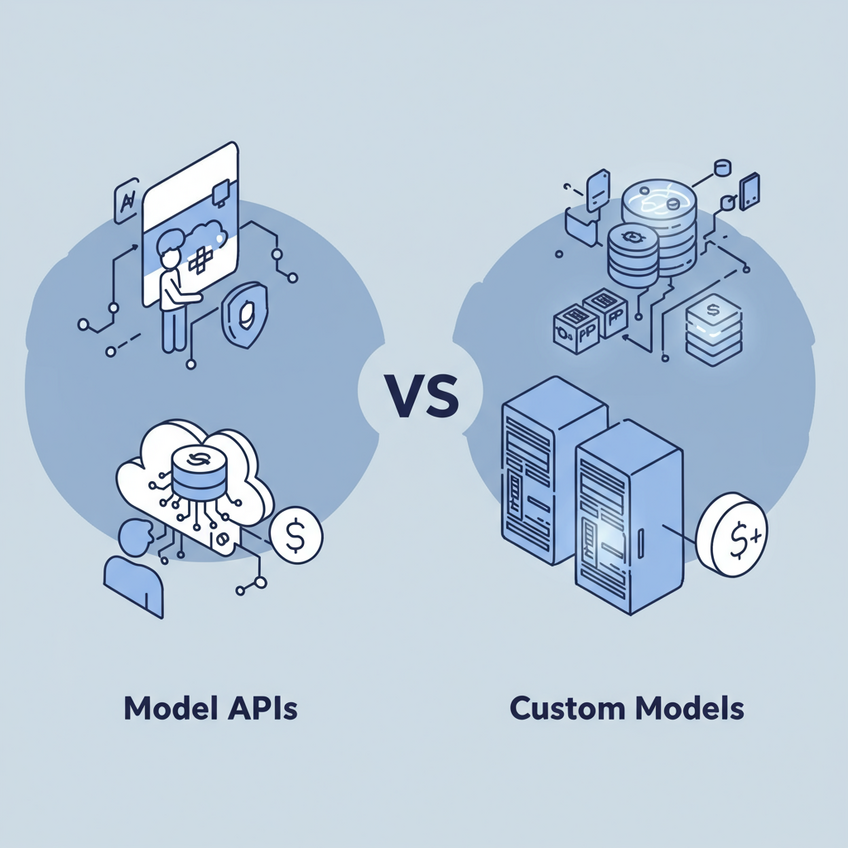
The cost of compute power, particularly for high-end GPUs, is a significant barrier to entry. According to Stanford’s 2024 AI Index Report, the training costs for state-of-the-art models have skyrocketed into the millions. As a startup, you cannot compete on this level. Instead, you must be strategic.
- Solution 1: Use pre-trained models via APIs: Before you even think about training a custom model, see if you can solve your problem using an API from a provider like OpenAI, Anthropic, or Cohere. This shifts the massive cost of training and hosting from you to them.
- Solution 2: Leverage serverless computing: For custom code and smaller models, use serverless platforms like AWS Lambda or Google Cloud Functions. This allows you to run your code without managing servers, and you only pay for the exact compute time you use, often down to the millisecond.
- Solution 3: Fine-tune smaller, open-source models: If you need a custom model, don’t start from scratch. Take a powerful open-source model (like Llama 3 or Mistral) and fine-tune it on your own small, high-quality dataset. This is exponentially cheaper and faster than training a large model from zero.
Here’s a quick comparison to guide your decision:
| Approach | Pros | Cons |
|---|---|---|
| Using Model APIs | Low cost, easy to implement, highly scalable | Less control, potential privacy concerns, dependent on vendor |
| Building Custom Models | Full control, can create unique IP, privacy-secure | Extremely high cost, requires deep expertise, slow to develop |
Finding and retaining talent without a massive budget
You don’t need a team of elite, expensive AI researchers from Google or Meta to build a successful AI business.
- Hire \”AI generalists\”: In the early stages, look for strong software engineers who are curious and capable of learning how to implement existing AI models and tools. A great engineer who can use an API is far more valuable than a researcher who can’t ship a product.
- Use fractional talent: For specialized, short-term needs (like setting up your MLOps pipeline or running a data labeling project), leverage fractional talent platforms like Toptal or Upwork. This gives you access to world-class expertise without the cost of a full-time hire.
- Sell the mission: You can’t compete with big tech on salary, but you can compete on mission and impact. Attract talent who are genuinely excited by the problem you are solving and who want to have a significant ownership stake in the outcome.
A practical framework for responsible and ethical AI growth
In 2025, building AI responsibly is not a burden; it’s a powerful competitive advantage. Many startups ignore this, seeing it as an enterprise-level concern, but this is a critical mistake. Implementing a simple, practical ethics framework from the start builds trust, attracts customers, and prevents costly mistakes down the line.
Why responsible AI is a competitive advantage, not a burden
Building with ethics in mind from day one gives you three distinct advantages:
- It builds trust: Customers are increasingly wary of AI. Demonstrating that you are thoughtful about fairness, privacy, and safety makes your product more attractive.
- It prevents debt: Fixing a biased algorithm or a privacy-violating data practice after you’ve scaled is exponentially more difficult and expensive than getting it right from the start. This saves you from significant technical and reputational debt.
- It’s future-proof: AI regulations are coming. By building on a responsible foundation, you ensure your business is prepared for future compliance requirements, not crippled by them.
Your simplified starter kit based on the NIST framework
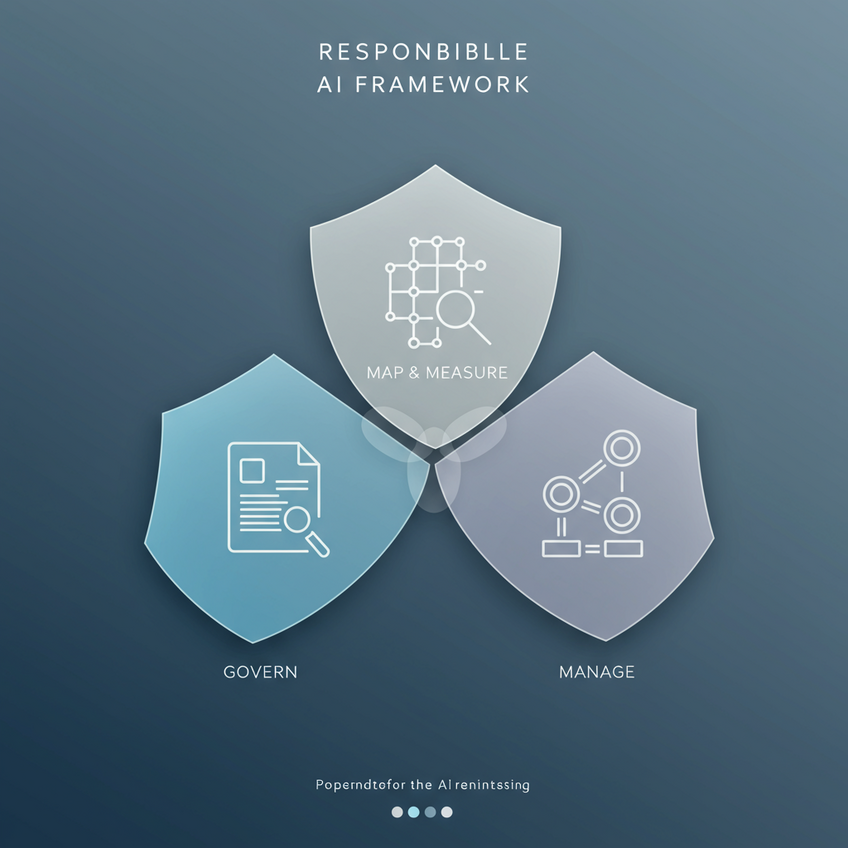
You don’t need a 100-page policy document. You can start by applying the core principles of the gold standard, the NIST AI Risk Management Framework, in a simplified way.
- Step 1: Govern: Write a one-page document that outlines your company’s principles for AI. For example: \”We will prioritize user privacy in all data handling,\” or \”We will be transparent about how our AI makes decisions.\” This becomes your north star.
- Step 2: Map & measure: For each AI feature you build, spend 30 minutes brainstorming potential risks. Could the training data be biased? Could the output cause harm? Then, create a simple test to measure that risk.
- Step 3: Manage: Once you identify a risk, have a clear, simple plan for what to do. This could be finding a more balanced dataset, adding a human review step, or simply being transparent with the user about the model’s limitations.
Applying a strategic framework like this is similar to the approach we take in our AI SEO Playbook, where a structured process leads to superior and more reliable outcomes.
What is the future of AI startups?
The AI landscape is evolving at a breakneck pace. To build a sustainable business, you need to not only master the present but also anticipate the future. Understanding the key trends will help you find durable opportunities and avoid building a business on yesterday’s technology.
Key trends to watch in 2025 and beyond
While the AI world is vast, a few key trends, many highlighted in research from institutions like Stanford HAI, are shaping the future for startups.
- The rise of vertical AI: The era of building another general-purpose chatbot is over. The real opportunity lies in creating deep, industry-specific solutions that solve a unique and costly problem for a niche audience.
- The shift to multimodality: AI is no longer just about text. Models that can understand and generate text, images, audio, and video simultaneously are creating entirely new product categories. Think of an app that can analyze a picture of a meal and generate a recipe, a shopping list, and a cooking video.
- The viability of AI agents: Autonomous agents that can execute complex tasks will move from theory to practical business models. Startups that can build reliable agents for specific workflows (e.g., an automated sales development representative) will command high value.
The competitive landscape is dominated by giants like Microsoft and Nvidia, but this is an advantage for startups. They are building the “picks and shovels.” Your job is to find a unique, profitable niche they are too big to serve, not to compete with them head-on.
Your next steps to sustainable AI business growth
We’ve covered a lot of ground, but the core message is simple: build a smart strategy, use a lean tech stack, anticipate challenges, and grow responsibly. Your journey starts with a single step. Go back to the phased implementation roadmap and define your MVP. What is the single most important problem you can solve for a customer right now? Start there. You have the potential to build a remarkable, impactful AI business.
Frequently asked questions about scaling an AI business
How do you scale an AI model?
You scale an AI model by increasing its capacity to handle more data and requests, typically through technical strategies like optimizing code, using more powerful hardware (scaling up), or distributing the workload across multiple machines (scaling out).
How to scale your business with AI?
You scale your business with AI by identifying key processes that can be automated or optimized, such as customer support, marketing, or data analysis, and then implementing targeted AI tools and strategies to improve efficiency and decision-making.
What is the AI business strategy in 2025?
The key AI business strategy in 2025 is to focus on creating specialized, vertical-specific solutions that solve a clear industry problem, while maintaining capital efficiency and building with a strong framework for responsible AI.
How do I start my own AI business?
You can start your own AI business by first identifying a specific problem you can solve, choosing a lean business model like an ‘AI wrapper’ or vertical solution, building a minimum viable product using pre-trained models, and then iterating based on user feedback.
From idea to impact: your journey in scaling starts now
Scaling an AI business in 2025 isn’t about having the biggest budget or the most complex algorithm. It’s about having the smartest, leanest, and most responsible strategy. It’s about out-thinking, not out-spending, the competition.
By focusing on the four pillars we’ve discussed—a clear strategy, a lean tech stack, a proactive approach to challenges, and a commitment to responsible growth—you can build a resilient and impactful company. The path from idea to impact is challenging, but it has never been more accessible. Now is the time to take that first step.
Ready to put these strategies into practice? Download our free AI Business Scaling Checklist to track your progress.
 Rankenstein
Leave a comment