
The dawn of 2025 has solidified a truth many saw coming: Artificial Intelligence is no longer a futuristic buzzword in Search Engine Optimization (SEO); it’s the engine driving its evolution. For marketers, SEO professionals, and business owners, navigating this AI-transformed landscape can feel daunting. Uncertainty abounds regarding how to adapt strategies, which tools to trust, and how to maintain, let alone achieve, top search rankings. If you’re grappling with manual content creation bottlenecks, the challenge of Google’s ever-smarter algorithms, or the fear of falling behind AI-savvy competitors, you’re not alone. This is precisely why this playbook exists. Consider this your definitive master guide to not just surviving, but thriving in the AI-driven SEO era. We will embark on a journey from foundational understanding to advanced tool implementation, equipping you with the knowledge and strategies to strategically integrate AI for unprecedented content ranking, streamlined workflow efficiency, and future-proof SEO success. This article will unpack the AI revolution in search, detail how to master the AI-powered content lifecycle, introduce the essential AI toolkit for 2025, and outline strategic adaptations to ensure your SEO efforts are resilient and effective for years to come.
- The AI Revolution in Search: Understanding the 2025 SEO Landscape
- Mastering the AI-Powered Content Lifecycle for #1 Rankings
- The Essential AI Toolkit for SEO Excellence in 2025
- Strategic Adaptation: Future-Proofing Your SEO in the Age of AI
- References & Further Reading
The AI Revolution in Search: Understanding the 2025 SEO Landscape
The integration of Artificial Intelligence into search engine mechanisms is fundamentally reshaping the SEO landscape as we head further into 2025. AI’s influence extends deep into how search algorithms operate, what factors determine rankings, and how users interact with search results, most notably through innovations like Google’s AI Overviews. Understanding these shifts is paramount for anyone looking to maintain visibility and achieve top rankings. What will AI SEO look like in 2025? It’s a dynamic blend of sophisticated content understanding, hyper-personalized user experiences, and an increasing reliance on AI tools to augment human expertise. SEO practices are evolving from keyword-centric approaches to more holistic, intent-driven strategies. As Brian Dean of Exploding Topics aptly puts it, AI presents both a “short-term opportunity” and a “long-term threat” for SEO [1]. While AI tools offer unprecedented efficiency, the core challenge lies in adapting to an AI-driven future strategically. This involves not abandoning traditional SEO wisdom but augmenting it with AI capabilities. For further insights into Google’s stance on AI-generated content, their Google’s AI Content Guidance is a valuable resource. An academic perspective on AI’s broad impact can be found in the CSU on AI’s SEO Impact blog.
Liz Reid, VP and Head of Google Search, has emphasized that AI Overviews are designed to help with more complex questions and aim to send valuable traffic to websites, stating, “the links included in AI Overviews get more clicks than if the page had appeared as a traditional web listing for that query” [2]. This signals Google’s intent to continue valuing and directing users to quality content sources, even within AI-generated summaries. Industry analysts like Gartner and Forrester have long predicted AI’s transformative impact across technologies, and search is a prime example of this, with AI now integral to information retrieval and presentation [3].
How AI is Redefining Ranking Factors and Search Algorithms in 2025
Artificial Intelligence is fundamentally changing SEO practices by shifting the emphasis of ranking factors. In 2025, search algorithms, powered by advanced AI like Natural Language Processing (NLP) and machine learning, are more adept than ever at understanding the nuances of user intent, content quality, and E-E-A-T (Experience, Expertise, Authoritativeness, Trustworthiness). Key AI trends impacting SEO include a deeper focus on semantic search, where the context and relationships between words matter more than exact keyword matches. Google’s own advancements, such as BERT and MUM, exemplify this, allowing algorithms to comprehend complex queries and content with near-human understanding [4]. This means content must genuinely satisfy the user’s underlying need, not just tick keyword boxes. According to insights from industry leaders like those on the Forbes Agency Council, AI is compelling a move towards more user-centric strategies where content depth, relevance, and demonstrable expertise are paramount [5].
Google’s AI Overviews: Optimizing for the New SERP Frontier
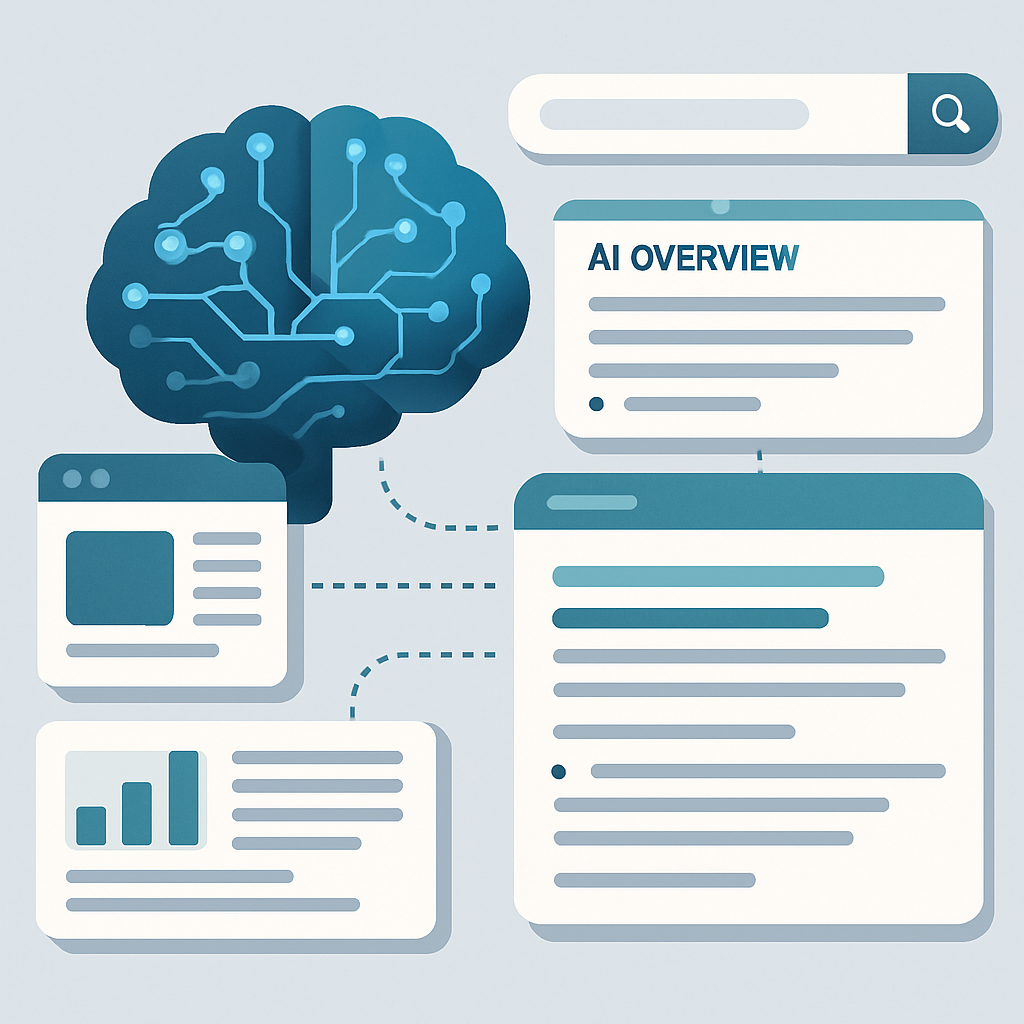
Google’s AI Overviews represent a significant evolution in how search results are presented, and by early 2025, all Google users in the U.S. are receiving these AI-generated snippets at the top of their search results for many queries [6]. This makes optimizing for inclusion in AI Overviews a critical strategy. So, how do you optimize content for Google’s AI Overviews using AI? It involves creating comprehensive, trustworthy, and “snippet-friendly” content. Google’s official stance, as highlighted by Liz Reid, is that “links included in AI Overviews get more clicks” and they are committed to approaches that “send valuable traffic” [2]. Research from platforms like SE Ranking suggests that pages already appearing in Featured Snippets and “People Also Ask” (PAA) boxes have a higher likelihood of being featured in AI Overviews [7]. This implies that content structured for clarity, direct answers, and comprehensive coverage of a topic is favored. AI tools can assist in identifying questions AI Overviews aim to answer and in structuring content to be easily digestible by AI. For more on Google’s policies regarding AI content, refer to Google on AI-Generated Content.
Beyond Google: The Broader AI Search Ecosystem in 2025
While Google dominates the search landscape, the AI revolution is also fostering the growth of alternative AI-powered search engines and specialized search functionalities. In 2025, we are seeing emerging AI technologies applied in niche search platforms, conversational AI interfaces, and in-app search experiences that go beyond traditional web search [8]. These platforms may leverage different AI models and prioritize different types of information or user interactions. Staying aware of this broader AI search ecosystem can reveal new opportunities for visibility and traffic, particularly for specialized content or audiences. The principles of creating high-quality, authoritative content remain relevant, but the specific optimization tactics might need to adapt to the unique ways these alternative AI search systems discover and present information.
Mastering the AI-Powered Content Lifecycle for #1 Rankings
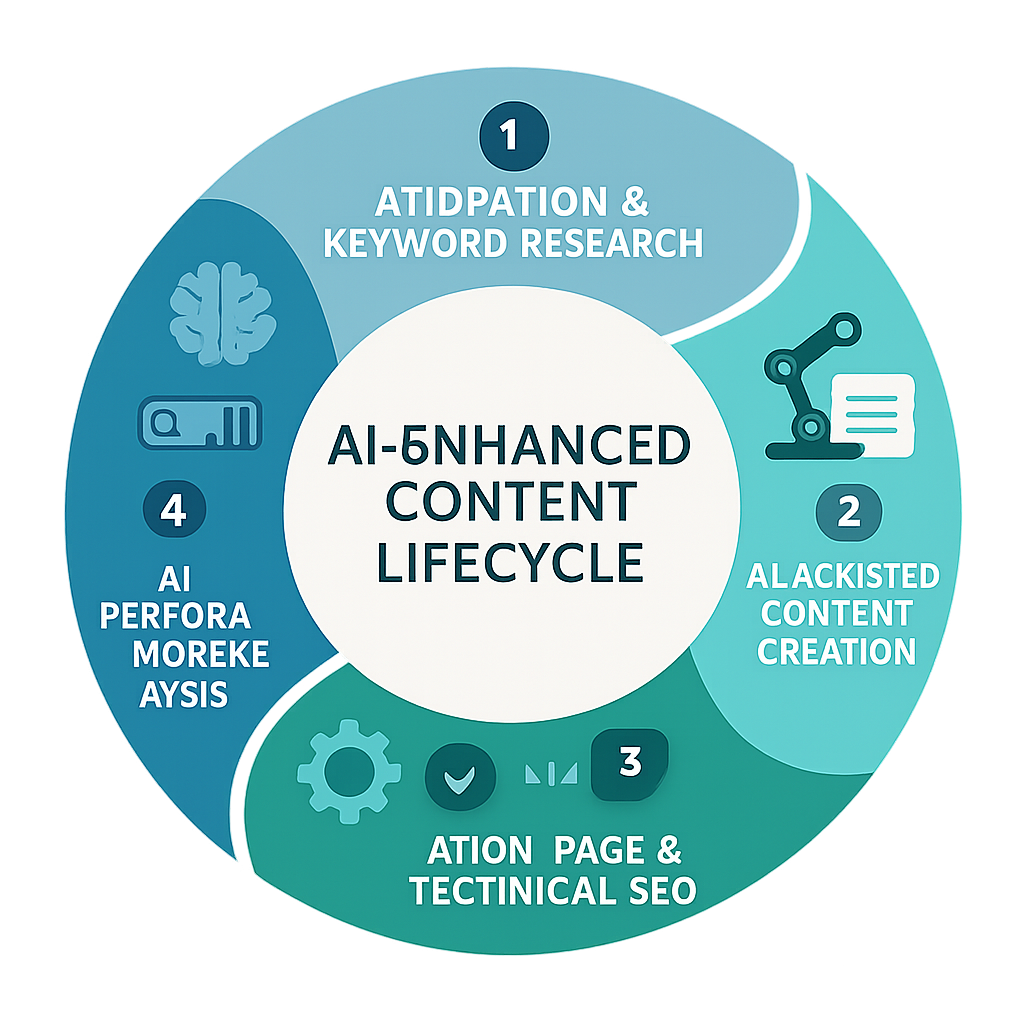
Achieving top rankings in 2025 requires a strategic integration of Artificial Intelligence across the entire content lifecycle – from the spark of an idea to the analysis of its performance. This holistic approach, blending AI’s power with human oversight, is key to not only producing content efficiently but also ensuring it meets the sophisticated demands of modern search engines and user expectations. The goal is to move beyond manual bottlenecks and leverage AI for content workflow automation, ultimately creating a well-oiled machine that consistently produces high-ranking articles. Hypothetical case studies and early-stage examples show that businesses adopting AI in their SEO workflows are seeing improvements in content output, relevance, and search visibility [9]. Frameworks inspired by insights from organizations like ForageGrowth, which discusses how AI can eliminate content bottlenecks, suggest a structured approach: identify repetitive tasks, select appropriate AI tools, integrate them into your existing processes, and continually refine based on performance data [10].
AI-Assisted Ideation & Advanced Keyword Research
The content lifecycle begins with ideation and keyword research, areas where AI offers a significant competitive advantage. AI tools can supercharge brainstorming by analyzing vast datasets to uncover trending topics, predict emerging search interests, and identify content gaps your competitors haven’t addressed. For instance, AI can help build comprehensive topic clusters, ensuring your content strategy covers a subject area with depth and authority. When it comes to keyword research, AI moves beyond simple volume and difficulty metrics. AI-powered platforms, including advanced features in tools like Semrush and Ahrefs, or specialized AI keyword tools like Seo.ai, excel at uncovering semantic relationships between keywords, identifying valuable long-tail variations, and understanding the nuanced intent behind search queries [11]. This allows for a more sophisticated keyword strategy that targets users at different stages of their journey. As noted by digital marketing authorities like Neil Patel, AI can significantly enhance the precision and scope of keyword research [11]. For an educational perspective on AI tools for keyword research, the NC State AI in SEO Guidance offers useful insights. AI also excels at competitive content gap analysis, pinpointing opportunities where your content can provide superior value.
Crafting High-Quality, SEO-Optimized Content with AI Writing Tools
Once ideas and keywords are established, AI writing tools like Jasper, Rytr, and ChatGPT can assist in drafting, refining, and optimizing content. These tools can generate outlines, draft initial sections, rephrase sentences for clarity, and even help tailor tone and style for specific audiences. The key to leveraging AI writing tools effectively for an AI blog writing strategy in 2025 is to balance AI generation with human oversight. While AI can accelerate content production, human expertise is crucial for ensuring accuracy, originality, infusing unique insights, and maintaining the E-E-A-T signals that Google values. As Dentsu highlighted from Google’s guidance, the core message remains to create “unique, non-commodity content that visitors from Search and your readers will find helpful and satisfying” [12], even when using AI. Therefore, AI should be viewed as an assistant that augments human creativity and strategic direction, not a complete replacement. The optimal approach involves using AI for initial drafts or specific tasks, followed by thorough human review and editing to enhance quality, inject personality, and ensure factual correctness.
AI for On-Page & Technical SEO Optimization
AI’s capabilities extend powerfully into on-page and technical SEO optimization, helping to fine-tune content and site structure for maximum search engine visibility. AI tools can analyze existing content and suggest improvements for titles, meta descriptions, header structures, and internal linking opportunities, ensuring they are keyword-relevant and compelling to users. For instance, ChatGPT can be used for summarizing content into concise meta descriptions or generating alternative title options [13]. Beyond on-page elements, AI is increasingly valuable for technical SEO tasks. AI-powered schema markup generators can help create structured data that allows search engines to better understand the content on your pages, potentially leading to rich snippets in SERPs. Furthermore, AI can assist in conducting comprehensive site audits, identifying technical issues like broken links, crawl errors, or site speed problems more efficiently than manual methods. Guidance from sources like Convert.com emphasizes optimizing content for generative AI, which includes proper schema implementation to make content more understandable and usable by AI systems [14].
Leveraging AI for Search Intent Analysis and User-Centric Content
Understanding user search intent – the why behind a query – is more critical than ever, and AI provides powerful tools to decode it. AI algorithms, particularly those employing NLP and machine learning, can analyze search queries beyond literal keywords to discern whether a user is seeking information (informational intent), looking for a specific website (navigational intent), intending to make a purchase (transactional intent), or researching before a purchase (commercial intent). Insights from platforms like GetFocal.co and Algolia demonstrate how AI can identify these intent types with remarkable accuracy [4] [15]. Google’s own BERT update significantly improved its understanding of 1 in 10 English language searches in the US by better grasping context and nuance [4]. By leveraging AI for search intent analysis, content creators can develop hyper-relevant, user-centric content that directly addresses the user’s underlying needs. A practical framework involves using AI-derived intent insights to map content types to specific stages of the user journey, ensuring that each piece of content serves a clear purpose and effectively guides the user.
AI-Driven Performance Analysis and Content Refinement
The content lifecycle doesn’t end with publication; continuous analysis and refinement are crucial for sustained SEO success. AI tools are increasingly adept at analyzing content performance, identifying underperforming pages, and pinpointing areas for improvement. Predictive SEO, powered by AI, can even forecast emerging search trends and potential shifts in user behavior, allowing for proactive content optimization. As highlighted by sources like OWDT and Salesforce, AI’s role in predictive analytics can inform SEO strategy by anticipating what content will resonate in the future [16]. AI can also enhance A/B testing by automating the process of creating variations and analyzing results, leading to more effective conversion rate optimization. By integrating AI into performance analysis, SEO professionals can gain deeper insights faster, enabling data-driven decisions to refine content strategies, improve rankings, and maximize ROI.
The Essential AI Toolkit for SEO Excellence in 2025
Navigating the burgeoning landscape of AI SEO tools can be overwhelming. To achieve SEO excellence in 2025, it’s crucial to identify and master a core set of AI tools that align with your specific needs for keyword research, content generation, optimization, and workflow automation. The best AI writing tools and SEO platforms are those that not only offer powerful features but also integrate smoothly into your processes, enhancing rather than complicating your efforts. When evaluating tools, consider hands-on reviews, user testimonials from platforms like G2 or Capterra [17], and how well their output quality meets your standards. A detailed comparison considering features, pricing, and ideal use cases for tools such as Quillbot, Wordtune, Jasper, Copy.ai, SurferSEO, and Frase can be invaluable.
Top AI Tools for Keyword Research & Competitive Analysis
For foundational SEO tasks like keyword research and competitive analysis, AI tools offer unprecedented depth and efficiency. Leading platforms like Semrush and Ahrefs are increasingly integrating sophisticated AI features to augment their traditional keyword research capabilities. Specialized tools like SurferSEO and Seo.ai leverage AI to uncover semantic keyword opportunities, analyze search intent with greater accuracy, and provide detailed insights into competitor strategies. These tools often go beyond simple volume and difficulty metrics, offering features like keyword clustering based on topical relevance and identifying content gaps by analyzing top-ranking pages. Insights from resources such as Fritz.ai or Neil Patel Digital often highlight how these AI-driven approaches compare favorably to traditional methods by providing a more nuanced understanding of the search landscape [11] [18]. The ability of AI to process vast amounts of SERP data allows for a much more granular analysis of what makes content rank for specific queries.
Leading AI Writing & Content Generation Platforms
When it comes to content creation, AI writing assistants and generation platforms have become indispensable for many. Tools like Jasper (formerly Jarvis), ChatGPT, Rytr, Copy.ai, and ContentBot offer a range of capabilities, from generating blog post outlines and drafting initial paragraphs to crafting marketing copy and social media updates. The strength of these platforms often lies in their versatility and speed. For instance, ContentBot is reportedly used by over 204,008 marketers, indicating widespread adoption [19]. However, the nuance lies in selecting the right tool for the specific task and understanding its output quality. Some tools excel at long-form content, while others are better for short-form copy or brainstorming. The key is to evaluate them based on the quality and relevance of their output for your specific content types and to always incorporate human review and editing to ensure originality, accuracy, and alignment with your brand voice. This addresses a common gap: the need for analysis focusing on the nuance and quality of output from different tools when applied to specific writing tasks.
AI-Powered SEO Optimization & SERP Analysis Tools
Beyond content creation, a suite of AI-powered tools focuses specifically on SEO optimization and SERP analysis. Platforms like SurferSEO, Frase, MarketMuse, and Clearscope, along with AI features in broader SEO suites like SE Ranking, help users optimize existing content and identify opportunities by deconstructing top-ranking pages. These tools typically analyze SERPs for target keywords, identify common elements among top performers (e.g., word count, heading structure, common keywords, E-E-A-T signals), and provide actionable recommendations for improving your content. They can help identify content gaps within your own articles and suggest entities or topics to include for greater comprehensiveness and relevance. As developers of these leading AI-powered SEO tools often share, their platforms are designed to bridge the gap between content creation and SEO performance by providing data-driven insights into what search engines are rewarding [20].
AI Tools for Workflow Automation & Efficiency
A significant advantage of AI in SEO is its ability to automate repetitive tasks and streamline entire content workflows. While specialized AI content automation platforms exist, tools like Zapier and IFTTT can also play a crucial role by connecting various AI applications and other marketing software to create automated sequences. For example, an idea generated in a brainstorming tool could automatically populate a content calendar, trigger a draft in an AI writer, and then schedule a review task. AI workflow automation tools are maturing, offering customization for tasks like social media content scheduling, image alt-text generation, and even initial SEO audits [21]. Platforms like ContentBot also offer features geared towards automation. By identifying bottlenecks in your current workflow, you can strategically implement AI tools to handle time-consuming tasks, freeing up human resources for more strategic activities.
Choosing the Right AI Tools: A Decision-Making Framework
With a plethora of AI SEO tools available, selecting the right ones for your specific needs is crucial. A decision-making framework can help. Start by clearly defining your goals: Are you looking to improve keyword research, accelerate content creation, optimize existing pages, or automate workflows? Next, consider your budget, team size, and the technical expertise available. Many tools offer tiered pricing and varying levels of complexity. Evaluate tools based on their core functionalities, ease of use, integration capabilities with your existing MarTech stack, and the quality of their output or insights. Look for user reviews and case studies, but also try to test tools yourself through free trials or demos. It’s also vital to consider the ethical implications and limitations of any AI tool you adopt, particularly for content generation, ensuring transparency and maintaining quality standards [22]. Answering questions like “What are the ethical considerations and limitations when using AI writing tools?” is an important step in this selection process.
Strategic Adaptation: Future-Proofing Your SEO in the Age of AI
The rapid evolution of AI in search necessitates a proactive and strategic approach to future-proofing your SEO efforts. It’s not just about adopting new tools; it’s about cultivating an AI-resilient mindset and developing strategies that can withstand ongoing changes in algorithms and user behavior. As Brian Dean wisely advises, while AI presents opportunities, it’s essential to “milk SEO for everything it’s worth while shifting resources toward future-proofing your strategy” [1]. A cornerstone of this future-proofing is an unwavering commitment to E-E-A-T (Experience, Expertise, Authoritativeness, Trustworthiness), as these human-centric qualities become even more critical differentiators in an AI-driven search landscape [1].
Developing an AI-Resilient SEO Strategy for 2025 and Beyond
An AI-resilient SEO strategy for 2025 and beyond is built on several key pillars. Firstly, prioritize creating exceptionally high-quality, original content that genuinely serves user needs. As Google consistently advises, and as echoed by Dentsu, the focus should be on “content that fulfils people’s needs. Focus on making unique, non-commodity content that visitors from Search and your readers will find helpful and satisfying” [12]. Secondly, double down on user experience (UX), ensuring your site is fast, mobile-friendly, easy to navigate, and provides a satisfying journey. Thirdly, build topical authority by comprehensively covering subjects relevant to your audience, demonstrating deep expertise. A detailed roadmap for 2025 preparedness should include regular content audits, ongoing keyword research that adapts to evolving search intent, and a commitment to technical SEO excellence [1]. Finally, embrace continuous learning and be prepared to adapt as AI technologies and search engine algorithms continue to evolve.
Overcoming Manual Content Bottlenecks with AI
Manual content creation workflows are often plagued by bottlenecks that stifle productivity and slow down output. Common pain points include time-consuming idea generation, lengthy research phases, writer’s block, tedious editing and optimization tasks, cumbersome approval cycles, and manual efforts for tasks like generating alt-text for images. AI offers powerful solutions to alleviate these pressures. For instance, AI brainstorming tools can rapidly generate content ideas and outlines. AI writing assistants can help overcome writer’s block by providing starting points or rephrasing existing content. For repetitive tasks, such as generating alt-text for thousands of images (Amnet.com highlighted a case involving over 9,000 images manually processed [23], AI can offer significant time savings. As Proofed.com notes, editorial bottlenecks can impact the entire content process [24], and AI can help streamline reviews by summarizing content or checking for basic errors before human review. By strategically integrating AI tools, teams can significantly improve content efficiency and focus human talent on higher-value strategic and creative tasks.
Diagnosing and Fixing Low Google Rankings in the AI Era (2025 Focus)
Experiencing low Google rankings in 2025 can be frustrating, especially with AI’s increasing influence on search. Common culprits often include issues with content quality (thin, unoriginal, or not satisfying user intent), a weak or toxic backlink profile, and technical SEO problems. Backlinko notes that Google considers approximately 200 ranking factors [25], while LYFE Marketing emphasizes that too many low-quality backlinks can harm SEO [26]. In the AI era, search engines are becoming even more sophisticated at identifying low-quality, unhelpful, or manipulative content, potentially including new forms of AI-generated spam [27]. A diagnostic checklist for low rankings should include:
- Content Quality Audit: Is your content comprehensive, accurate, original, and does it demonstrate strong E-E-A-T? Does it truly answer the user’s query?
- Backlink Profile Analysis: Are your backlinks from authoritative, relevant sources? Are there toxic links that need disavowing?
- Technical SEO Health Check: Are there crawl errors, indexing issues, poor site speed, or mobile usability problems? Is schema markup correctly implemented?
- User Experience Review: Is your site easy to navigate? Is the bounce rate high, indicating users aren’t finding what they need?
Addressing these areas, with a keen understanding of how AI assesses content and site quality, is crucial for recovering and improving rankings.
The Human Element: Balancing AI with Expertise and Ethical Considerations

While AI offers transformative capabilities for SEO, the human element remains indispensable. The question “Will AI replace SEO professionals by 2025?” is common, but the reality is more nuanced. AI excels at data processing, pattern recognition, and automating repetitive tasks. However, human strategy, critical thinking, creativity, empathy, and ethical judgment are qualities AI cannot replicate. An effective AI-human workflow leverages AI as a powerful assistant, augmenting human expertise rather than replacing it. SEO professionals will increasingly focus on strategic oversight, interpreting AI-driven insights, ensuring content quality and originality, building genuine brand authority, and navigating complex ethical considerations. These ethical considerations are significant and include preventing the spread of AI-generated misinformation, addressing potential biases in AI algorithms, ensuring transparency in the use of AI-generated content, and managing the human impact of AI adoption within teams, such as providing training and overcoming resistance to change [28]. A robust ethical framework is crucial for building and maintaining trust with both users and search engines.
As we navigate the AI-driven SEO landscape of 2025, it’s clear that Artificial Intelligence is not just a fleeting trend but a fundamental shift. The strategies and tools discussed in this playbook offer a pathway to not only adapt but to excel. By understanding AI’s impact on search, mastering the AI-powered content lifecycle, selecting the right AI toolkit, and strategically future-proofing your approach, you can achieve unprecedented content ranking and workflow efficiency. The key is strategic integration, continuous learning, and a commitment to quality and user value. The power of AI, guided by human expertise and ethical considerations, will define SEO success in the years to come.
Start implementing these AI-driven SEO strategies today to future-proof your content, dominate search rankings in 2025, and unlock new levels of workflow efficiency. Share your experiences or questions about AI in SEO in the comments below!
The field of AI and SEO is rapidly evolving. Information and tool recommendations are current as of the publication date but may change. This article provides guidance and strategies, not financial or guaranteed ranking advice.
References & Further Reading
- Dean, B. (2025). AI & SEO: How to Prepare in 2025. Exploding Topics. Retrieved from https://explodingtopics.com/blog/ai-in-seo
- Reid, L. (2024, May). AI Overviews in Search: Helping with more complex questions. Official Google Search Blog. Retrieved from https://blog.google/products/search/ai-overview-expansion-may-2024-update/
- Gartner, Inc. & Forrester Research. (N.D.). Various reports and analyses on AI technology trends.
- GetFocal.co. (2024). AI for Search Intent: Comprehensive Guide 2024. Retrieved from https://getfocal.co/post/ai-for-search-intent-comprehensive-guide-2024
- Forbes Agency Council / Xponent21. (N.D.). Articles discussing AI’s impact on SEO.
- PurposeBrand. (N.D.). Super Snippet SEO: How to Optimize Your Content for Google AI Overviews. Retrieved from purposebrand.com/blog/super-snippet-seo-optimize-ai-overviews/
- SE Ranking. (N.D.). How to Optimize for AI Overviews: Best Practices & Real Examples. Retrieved from seranking.com/blog/how-to-optimize-for-ai-overviews/
- Various Sources. (N.D.). Discussions on emerging AI technologies in search.
- Various Sources. (N.D.). Discussions on AI adoption in SEO.
- ForageGrowth / Appian. (N.D.). Articles on AI eliminating content bottlenecks and AI workflow automation.
- Semrush / Ahrefs / Seo.ai / Neil Patel Digital. (N.D.). Resources on AI in keyword research.
- Dentsu. (2025). Google I/O 2025: What AI Means for the Future of SEO. Retrieved from https://www.dentsu.com/uk/en/blog/google-io-2025-what-ai-means-for-the-future-of-seo
- Various Sources. (N.D.). Discussions on AI tools for summarization and meta descriptions.
- Convert.com. (N.D.). How to Optimize Content for Generative AI. Retrieved from convert.com/blog/growth-marketing/how-to-optimize-content-for-generative-ai/
- Algolia. (N.D.). How to identify user search intent using AI and machine learning. Retrieved from algolia.com/blog/ai/how-to-identify-user-search-intent-using-ai-and-machine-learning
- OWDT / Salesforce. (N.D.). Articles on AI for predictive analytics in SEO.
- G2 / Capterra / Product Hunt. (N.D.). User review platforms for software.
- Fritz.ai. (N.D.). Best AI Tools for Keyword Research. Retrieved from fritz.ai/best-ai-tools-for-keyword-research/
- ContentBot.ai. (N.D.). Homepage/About section. Retrieved from contentbot.ai/
- SurferSEO / MarketMuse / Clearscope (Developers). (N.D.). Insights from developers of AI SEO tools.
- Medium. (N.D.). Articles by experts on AI workflow automation.
- Various Sources. (N.D.). Discussions on ethical considerations of AI writing tools.
- Amnet.com. (N.D.). From Manual Bottlenecks to AI-Driven Efficiency: Transforming Accessibility with Smart Alt-Text Generation. Retrieved from amnet.com/from-manual-bottlenecks-to-ai-driven-efficiency/
- Proofed.com. (N.D.). How to Overcome Content Bottlenecks. Retrieved from proofed.com/knowledge-hub/how-to-overcome-content-bottlenecks/
- Backlinko. (N.D.). Google Ranking Factors: The Complete List (2025). Retrieved from backlinko.com/google-ranking-factors
- LYFE Marketing. (N.D.). Important Google Ranking Factors for 2025. Retrieved from lyfemarketing.com/blog/google-ranking-factors/
- Various Sources. (N.D.). Discussions on AI identifying low-quality content.
- Various Sources. (N.D.). Discussions on human element in AI and change management.
 Rankenstein
Leave a comment